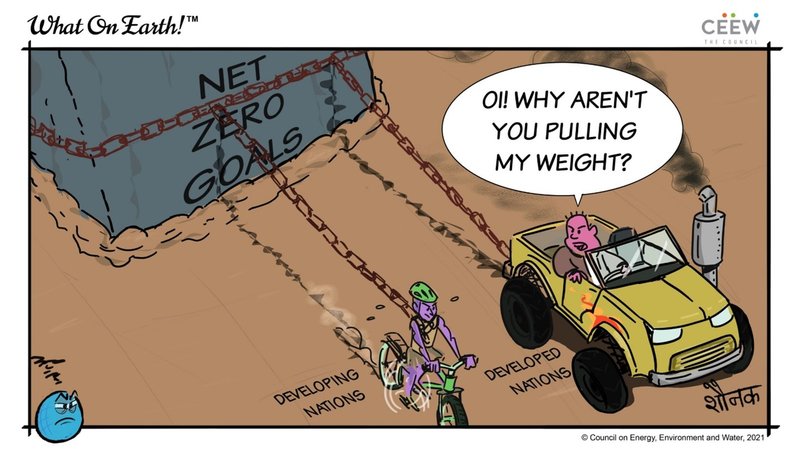
Kleine eilandstaten – welke zeer kwetsbaar zijn voor de gevolgen van klimaatverandering – vinden dat alle landen, dus ook opkomende economieën zoals India, meer actie moeten ondernemen [4]. Opkomende economieën zijn het daar niet mee eens en vinden dat ze al genoeg actie ondernemen [2]. Deze onenigheden spelen al een rol sinds de klimaattop van 2011, waar de basisprincipes voor onderhandelingen naar het klimaatakkoord van Parijs werden besproken en niet alle ontwikkelingslanden in gelijke mate bereid waren om zelf emissiereductiebeloftes aan te gaan [5][6].
Het perspectief dat ontwikkelde landen een grote verantwoordelijkheid hebben in het reduceren van emissies is verankerd in het klimaatverdrag uit 1992. Dit verdrag benadrukte dat ontwikkelde landen de leiding moeten nemen in het reduceren van emissies, terwijl bij ontwikkelingslanden juist (tijdelijke) groei in emissies en energiegebruik geaccepteerd werd in de context van industrialisatie, armoedebestrijding, en economische groei [7]. Hierop voortbouwend ondertekenden landen het Kyotoprotocol, dat wettelijk bindende emissiereductiedoelen oplegt aan ontwikkelde landen (niet alle ontwikkelde landen ratificeerde echter dit akkoord)[8]. Het klimaatakkoord van Parijs uit 2015 heeft een andere opbouw en vraagt alle landen vrijwillige doelstellingen te formuleren, onder het principe dat ieder land zelf haar ambitieniveau kan bepalen in lijn met nationale omstandigheden [9].
Waarom vinden lage-inkomenslanden dat hoge-inkomenslanden meer verantwoordelijkheid hebben voor het aanpakken van klimaatverandering?
Hoge-inkomenslanden hebben over het algemeen een hogere uitstoot per hoofd van de bevolking dan lage-inkomenslanden. Het figuur hieronder laat per landengroep het inkomen en de uitstoot per hoofd van de bevolking zien. De lage-inkomenslanden wijzen erop dat de grootste vervuilers rijke landen zijn, en dat het onrechtvaardig is om lage-inkomenslanden, welke toch al erg lage emissies hebben, achter de broek te zitten om emissies te reduceren.
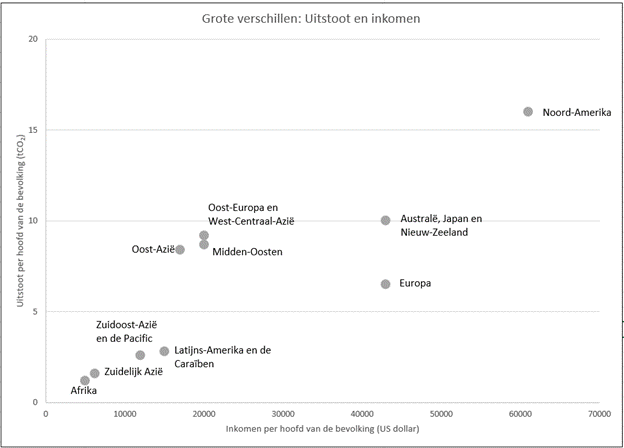
Figuur 2. Dit figuur laat zien dat er grote verschillen zijn tussen regio’s in termen van uitstoot en inkomen per hoofd van de bevolking. Noord-Amerika springt eruit als de regio met de hoogste inkomens en de hoogste uitstoot per hoofd van de bevolking. Afrika en Zuidelijk Azië (waaronder India) hebben juist lage inkomens en een lage uitstoot per hoofd van de bevolking. Bron: IPCC Sixth Assessment report [10].
Niet alleen de huidige emissies per hoofd van de bevolking zijn hoger in rijke landen. In de VS en Europa woont slechts 13% van de wereldbevolking, terwijl deze landen verantwoordelijk zijn voor 50% van de wereldwijde emissies sinds 1850 (historische emissies). Ter vergelijking, de minst ontwikkelde landen zijn ook goed voor 13% van de wereldbevolking, maar zijn slechts verantwoordelijk voor 0.4% van historische emissies [11].
Tot slot vinden lage-inkomenslanden dat ontwikkelde landen tekort zijn geschoten in het reduceren van emissies in de drie decennia sinds het ondertekenen van het eerste VN-Klimaatverdrag. Ontwikkelde landen samen reduceerden emissies met slechts 3.7% tussen 1990 en 2019 [12]. Niet echt een mokerslag. Zeker niet als je bedenkt dat een IPCC-scenario stelde dat ontwikkelde landen een reductie van 25–40% hadden moeten behalen voor 2020 om klimaatverandering te beperken tot 2 graden (c). In andere woorden, er is nog een uitstaande rekening.
Deze rekening proberen lage-inkomenslanden onder andere te verheffen middels het opstellen van een fonds voor klimaatschade (d). Een studie berekende dat kosten van klimaatschade in ontwikkelingslanden tegen 2030 tussen de 290 en 580 miljard per jaar zullen zijn [13]. Tijdens de klimaattop in Dubai (december 2023), kwamen landen tot een akkoord over het starten van zo’n klimaatschade fonds. Een aantal rijke landen beloofde gezamenlijk 661 miljoen dollar in het fonds te stoppen (e). Niet genoeg om alle klimaatschade te dekken, maar wel een belangrijk gebaar van internationale solidariteit.
Voetnoten
a) Overigens, landen met hoge uitstoot zoals de Verenigde Staten en de EU vermijden juist vaak het onderwerp van historische verantwoordelijkheid voor het veroorzaken van klimaatverandering. In plaats daarvan benadrukken zij de ‘collectieve’ verantwoordelijkheid van alle landen in het aanpakken van het klimaatprobleem.
b) Het VN-klimaatverdrag uit 1992 stipuleert in Artikel 3.1 “developed country Parties should take the lead in combating climate change”.
c) Zie ook de uitspraak over de Urgenda klimaatzaak, sectie 7. De rechter bevond dat er een hoge mate van internationaal consensus is dat ontwikkelde landen 25 – 40% moeten reduceren in 2020, en dat dit ook voor individuele landen geldt.
d) Het opstellen van een fonds voor klimaatschade is niet de enige manier waarop ontwikkelingslanden klimaatrechtvaardigheid proberen te operationaliseren. Ontwikkelingslanden proberen bijvoorbeeld ook sinds vele jaren financiering voor klimaatadaptatie omhoog te schroeven. Klimaatadaptatie gaat over het verhogen van de weerbaarheid tegen de effecten van klimaatverandering, zoals het bouwen van dijken tegen stijgende zeespiegels. Deze webpagina beschrijft de uitkomst over het fonds voor klimaatschade tijdens de klimaattop in 2022.
e) Deze webpagina bevat een overzicht van alle bijdragen aan het klimaatschadefonds.